
Energy Storage Systems (with off-grid capability)
More and more people want to save the renewable energy they’ve generated onsite to use it themselves later when they need it. While this has always been possible, it has become increasingly more cost-effective as the price of battery storage and energy storage systems have reduced, their cyclic efficiency has increased and the life of the battery itself has increased compared to the old lead acid batteries. The first well-known battery storage product was the Tesla Powerwall, and this has been followed by a number of similar products using lithium iron phosphate (LiFePO4) battery technology. Coupled with a modern inverter which can operate in parallel with the grid electricity supply or in standalone mode if the grid is disconnected, the flexibility such a system provides opens up a number of possibilities, including:
- Store on-site generated energy to use later, to minimise how much electricity you import from the grid at a high price.
- Have a back-up electricity supply during power cuts or blackouts.
- If you have access to ‘time of day’ electricity pricing – charge the batteries from the grid during the low-price export period and sell it back to the grid during the high price period.
The key components in an energy storage system are shown below.
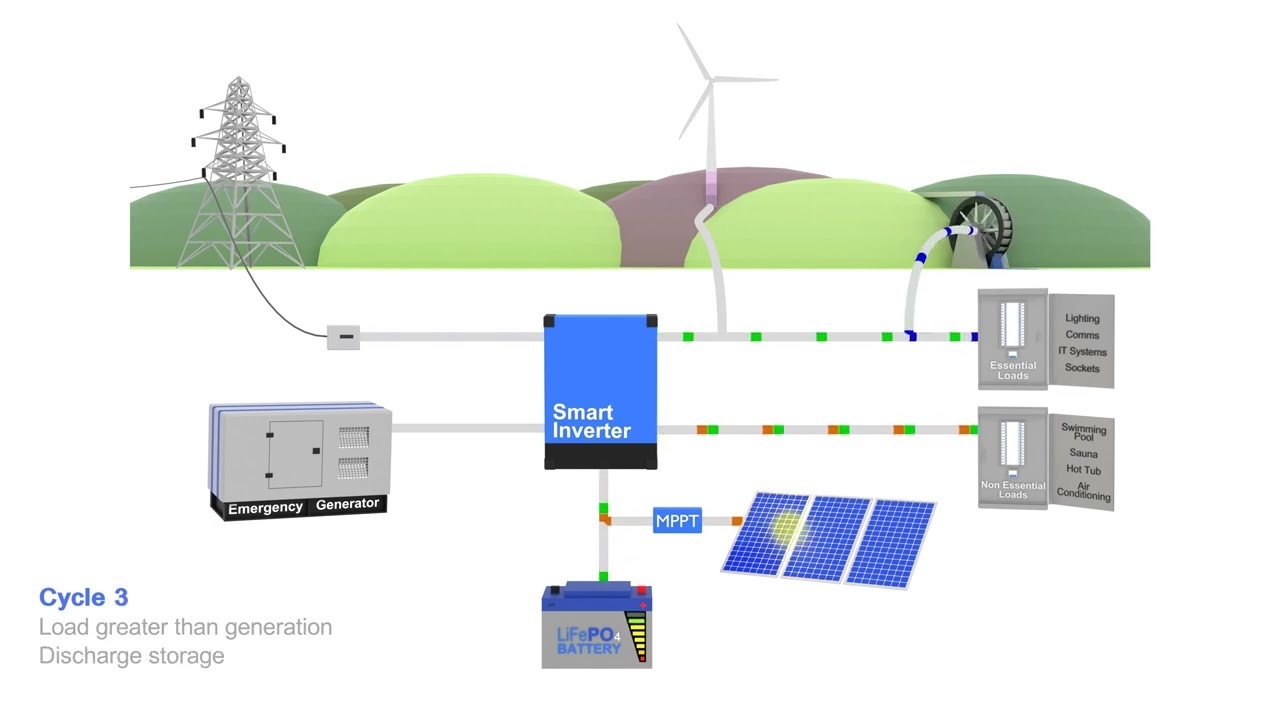
The heart of the system is the inverter / charger. Arguably the best inverter / chargers come from Victron Energy who have decades of experience of building off-grid capable electricity systems and have a reputation for building reliable products with long lives. The battery storage system connects to this; normally this is a Lithium Iron Phosphate (LiFePO4) battery. A few years ago, lead acid batteries would be used, but these are being superseded by LiFePO4 batteries in good quality systems due to the latter’s significantly better performance, improved efficiency and longer lifetime. An Energy Meter would be used between the inverter / charger and the grid to monitor the flow of energy to and from the grid – this is used when trying to maximise on-site energy use by diverting any excess energy from on-site generation to the batteries to charge them up, and only then allowing the system to export. Even then, if it is more cost-effective a relay can be triggered to dump any excess energy to hot water heating or a similar dump load. The other key component is your on-site energy generation, which is commonly solar PV, but could also be hydropower, wind power or another renewable energy source (or a conventional generator).
The size of the inverter / charger and battery storage is key to how the system will perform. We start Energy Storage System projects with a ‘site electrical loads and energy use analysis’ to understand what is currently used, then recommend a range of energy storage options of increasing power output and energy storage capacity that can power larger loads and for longer. Obviously larger systems cost more, and there is normally a sweet-spot where you can meet your essential loads for an acceptable length of time – the trick is deciding where this sweet-spot is. There is always the option of having a generator back-up as well-connected to the system in case there is a longer blackout during winter and the on-site generation (if solar PV) would struggle to keep up with energy consumption – again this adds to the cost, but also increases your energy security. Following the analysis of loads, we would also review any existing on-site electricity generation you have and identify any potential additional sources.
On the selection of equipment, Renewables First works to some key principles. The first is that we don’t want to be and are not the cheapest supplier because our clients are not driven by minimum cost. Our clients are paying us to specify the most efficient and best-performing equipment from manufacturers with a reputation for quality, long-term reliability and long-term product support. This inevitably means that we specify more expensive equipment, but it will be better-performing and more reliable in the future.
So, why should you trust Renewables First to design and build your Energy Storage System? We are an engineering-based business with an in-house team of experienced engineers that actually build stuff. We take projects from initial feasibility, through the consenting and design stages, then build and commission them, then help the owners operate and maintain them. We’ve been doing this since 2009 and have a long list of successful projects and happy clients. Our key differentiator is that we build systems, and only by building systems and sorting out all the teething issues can you truly develop the deep understanding needed to deliver reliable energy generation systems.
I’m interested – what is the next step?
- It starts with an ‘Energy Storage System Feasibility Study’ which includes:
- Site electrical loads and energy use analysis to understand your needs.
- An Electrical energy generation review; (existing and potential new sources).
- Outline system specification and performance modelling to present the system size options.
- Estimate of system costs.
- Conclusions and next steps.
- Design and specification. This stage develops the chosen system into a detailed design ready for implementation and a detailed specification of all parts, including wiring schematics.
- Installation and commissioning. This is the actual practical work to construct the system and get it operating.
- Ongoing Operation and Maintenance (O&M) support. We can provide routine and non-routine servicing and support services, including off-site support, which is particularly useful for remotely adjusting the operational parameters of your system.
If you would like to proceed, please submit an enquiry using our online Enquiry Form. Try to answer as many of the questions as possible, as this enables us to provide a more accurate response. Once we have had a look at the information you have provided, we will get in touch to discuss your enquiry in more detail, normally within a few days of receiving it.
Are you considering a low carbon renewable energy project?
Renewables First have considerable experience and full project capability, from initial feasibility studies through to system design and installation for Hydro, Wind, PV, Energy Storage Systems, Water and Ground Source Heat Pump Systems.
We also speciailise in consultancy for Energy independence / Back-up electricity systems, Net zero energy production, Off-grid / Standalone and Remote power systems
Please contact us about your low carbon energy project today.