
Hydropower
Planning & Regulation
Written by: Phil Davis, Managing Director at Renewables First and specialist in hydropower, wind power and solar power system design.
Reviewed by the Renewables First engineering team for technical accuracy.
Reviewed June 2026
Hydropower projects require various consents – Planning Permission, Environmental Consents, Grid Connection Permission.
Renewables First has years of experience developing hydropower projects and can assist you obtaining the required permissions.
Frequently Asked Questions
Do I need planning permission?
Do I need permission to connect to the grid?
The electrical connection is often overlooked but is vitally important; it doesn’t matter how good a hydropower site is if the energy generated cannot be exported into the distribution network.
Permission to grid connect must therefore be secured early during any project
Visit our Grid Connection page for more information
Will my scheme need an environmental licence or planning permission?
All small hydro and micro hydro systems must have hydro licensing issued by the environmental regulator, which is the Environment Agency (EA) in England and Wales, Scottish Environmental Protection Agency (SEPA) in Scotland and the Northern Ireland Environment Agency (NIEA) in Northern Ireland.
The process to obtain the licenses is a quite bureaucratic, particularly when dealing with the EA, and takes on average nine months for a typical site.
As well as a licence to use the water for the operation of the hydro system you will also need permission to do ‘work in the river’ while the system is constructed. This includes agreement on how works will be conducted to make sure the riverine environment is protected and also checks that all permanent structures and temporary works (i.e. coffer dams etc.) do not increase flood risk.
Planning permission will be required for any new structures, though generally this is simpler to obtain than the EA consents because hydropower systems are visually relatively unobtrusive. On technical and ecological matters the local authority generally defers to the environmental regulator, so provided your EA / SEPA / NIEA consents are all in order the planning consent should be forthcoming. It can be more complicated if the hydro system is integrated into a historic building, but even then this is normally possible in a sympathetic way which is acceptable to Conservation Officers.
Renewables First has over a decade of experience of securing environmental and planning consents for hydropower systems. More details are provided here.
Are hydro systems fish-friendly and will I need a fish pass?
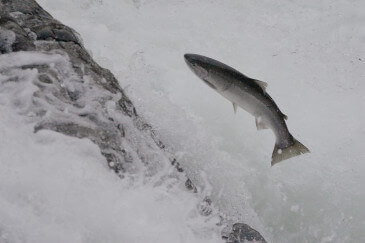
Jumping Steelhead – Photo courtesy of Greg Shields
Can I get fish-friendly hydro turbines and will I need a fish pass? Yes and maybe.
Historically it would have been possible for a poorly designed hydropower system to have a negative impact on fisheries, but the regulatory framework which governs hydropower licensing nowadays is quite rightly highly protective of fish, and provided the various good practice design guidance is followed hydro systems are at worst benign and at best have a positive impact of fisheries.
If a proposed hydro site is located on a river frequented by migratory fish you will almost certainly have to install a new, or upgrade the existing, fish pass.
The issues for fisheries are intake screening design and fish bypasses, fish passes and flows in parts of a river depleted of flow. All of these issues are highly regulated to ensure no negative impact on fisheries. In the case of fish passage, hydro projects often result in new or improved fish passage facilities being installed, and these fish passes are often much more effective because of the improved attractant flows towards the fish pass which result from co-locating it with the hydro system.
Renewables First always designs systems to be fish-friendly and where possible we aim to improve fish passage beyond the pre-hydro project situation. We have a lot of experience of designing all types of fish pass, fish surveys and everything to do with fish and hydropower.
On the subject of fish and hydropower you may come across the misinformation and misrepresentation of facts peddled by the Angling Trust. It is not known why the Angling Trust has chosen to adopt such a negative position in regard to hydropower and fisheries, but thankfully their opinions do not carry much weight with the environmental regulators. Unfortunately some anglers have only read the Angling Trust’s views on hydropower and adopt these as their own, which can cause problems. Over time this problem will diminish as hydropower gets more common and more anglers learn of the positive benefits to fisheries from hydropower.
Phil Davis
Manging Director | Renewables First
About the Author
Phil has worked in the renewables sector since 2001 and founded Hydro Generation, which became Renewables First in 2009.
A qualified mechanical engineer (BEng, MSc Renewable Energy Systems), Phil is a recognised expert in hydropower, wind and solar PV across all project stages.
Are you considering a hydropower project ?
Renewables First have considerable experience as a hydro consultant and have a full project capability, from initial feasibility study through to system design and installation.
The first step to develop any hydropower site is to conduct a full feasibility study.
Contact us about a feasibility study today!
Once complete, you will understand the site potential and be guided through the next steps to develop your project. You can read more about hydropower in our Hydro Learning Centre.
Minimise manual cleaning of your intake screen, maximise the financial return of you hydropower system and protect fish and eels, with GoFlo Travelling Screens. Find out more here.